Chapter Three

Operational Model for Cervical Cancer Elimination in Kenya

Overview

This chapter outlines the specific interventions that are proposed for implementation in the period 2025/26 to 2029/30, to put Kenya on the path to cervical cancer elimination.

Since its 2019 rollout, Kenya’s HPV vaccination program has remained low in coverage due to COVID-19 disruptions, limited access in marginalized communities, and systemic delivery and policy gaps; by 2023, only 54.7% of girls aged 10–14 had received one dose and 44.3% had completed two (figure 5).

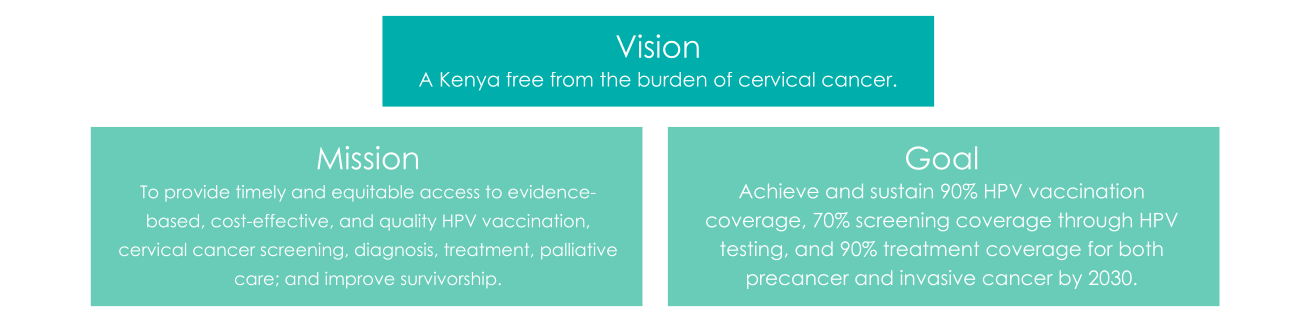
3.1 Vision, Mission, Goal and Core Values
Core Values
a. Integration

Deliberate alignment and incorporation of cervical cancer services—such as HPV vaccination, screening, diagnosis, and treatment—into existing health programs and platforms (e.g., PHC, maternal health, HIV, school health and community health) to ensure comprehensive and seamless delivery. This promotes efficiency, maximizes resource use, and improves outcomes by addressing women’s health needs within a unified framework.

b. Collaborations

Strategic partnerships between stakeholders—including government agencies (Ministries of health, education, interior), civil society, health providers, development partners, county governments, faith-based facilities, private sector and communities—focused on cervical cancer prevention and control. These collaborations leverage shared resources, knowledge, and expertise to accelerate progress toward common elimination goals.

c. Sustainability

The ability of cervical cancer interventions (such as HPV vaccination, screening, and treatment) to maintain their impact and operations over time by building local capacity, securing long-term financing, institutionalizing practices within the health system, and ensuring community ownership to reduce dependency on external support. Examples include domestic financing (PHC benefits), local equipment maintenance plans, and workforce retention.

d. Governance

The systems, structures, and processes through which cervical cancer programs are led and managed— ensuring accountability, transparency, equity, and responsiveness. Strong governance ensures clear roles, effective oversight, and alignment with national health priorities and policies. The structures include the Non- communicable Disease Interagency Coordinating Committee (NCD- ICC), the National Cervical Cancer Elimination TWG, County NCD TWGs and School Health Coordination mechanisms.

e. Advocacy and education

Activities that influence policy, raise awareness, and empower individuals and communities with information about cervical cancer prevention. This includes addressing misinformation, social listening/ misinformation trackers and adverse event following immunization (AEFI) communication protocols (HPV vaccine confidence), promoting HPV vaccination and screening uptake, and mobilizing public and political support for cervical cancer elimination.

f. Capacity building

Efforts to enhance the knowledge, skills, systems, and infrastructure necessary for effective cervical cancer prevention and care. This includes competency- based curricula, training health workers, e-learning, certification, mentorship, improving supply chains, upgrading diagnostic capabilities, and strengthening data and referral systems.

g. Coordination

The systematic organization and harmonization of cervical cancer efforts across stakeholders and sectors for coherent planning, resource use, implementation, and monitoring. Strong coordination avoids duplication, enhances efficiency, and ensures alignment with national strategies.

h. Equity

Achieving equity in cervical cancer elimination requires ensuring that all women, especially those in underserved and high-risk populations (rural, arid and semi-arid lands/ ASAL counties, informal settlements, women living with HIV, women with disabilities, migrants/refugees), have access to timely prevention, screening, and treatment services.

3.2 Key Result Areas (KRAs)

The operational focus of the elimination plan is structured around the three pillars of the cervical cancer elimination strategy, listed below. Interventions under each pillar are then grouped as per relevant health system building block. Cross-cutting issues including M&E/HIS, supply chain, financing, workforce, governance, community engagement, research/innovation are addressed specifically as they apply in each KRA.

Key Result Area 1: HPV vaccination
Key Result Area 2: Screening and precancer treatment
Key Result Area 3: Diagnosis, treatment, palliative and survivorship care for invasive cervical cancer.

3.3 Operational Objectives and Interventions
3.3.1 Key Result Area One: HPV Vaccination

This is the first pillar of the elimination initiative, as well as the most impactful and cost-effective of the cervical cancer elimination interventions. This KRA seeks to ensure that over 90% of girls are vaccinated against HPV by the time they attain 15 years of age, through a combination of school- based, health facility and community strategies.

Operational objective 1: Strengthen and expand equitable, timely, and integrated HPV vaccine delivery with the goal of achieving at least 90% coverage of girls by age 15 years, by the year 2030

Actions

  • Institutionalize school-based HPV vaccination delivery through outreaches in all public and private primary schools
  • Expand facility-based vaccination services to provide routine, accessible HPV vaccination services, including demand generation.
  • Expand and institutionalize HPV vaccination outreaches to marginalized and underserved communities.
  • Establish integrated mechanisms to track, follow- up, and improve school-based HPV vaccination outcomes.
  • Increase vaccination coverage for 10-year-old girls to at least 90%, and conduct periodic catch-ups for girls 11-14 years to reach those missed at 10 years.
  • Utilize innovative delivery approaches targeting missed opportunities plus zero dose girls.

Operational objective 2: Strengthen the capacity, motivation and availability of the health workforce to deliver HPV vaccines safely and effectively.

Actions

  • Strengthen the skills, motivation, and performance of healthcare workers and CHPs through structured, ongoing capacity-augmentation interventions.
  • Establish an annual recognition and learning exchange platform to reward high-performing counties and promote best practice sharing.

Operational objective 3: Strengthen the health information system to ensure complete, timely, and integrated data capture, reporting, and decision making on HPV vaccination across public and private sectors by 2030.

Actions

  • Strengthen the skills, motivation, and performance of healthcare workers and CHPs through structured, ongoing capacity-augmentation interventions.
  • Establish an annual recognition and learning exchange platform to reward high-performing counties and promote best practice sharing.
  • Enhance adoption of vaccination modules into facility electronic health records systems (EHR) being rolled out countrywide, and their use at all vaccination points.
  • Upgrade and integrate the Logistics Management Information System (LMIS) and make it end to end for utilization facility level.
  • Enhance data quality to ensure consistency and accuracy between the source document /files and reporting including KHIS.
  • Improve projection and forecasting of the number of in-school and out-of-school girls by county.
  • Include HPV in coverage surveys to enable triangulation of administrative data on HPV